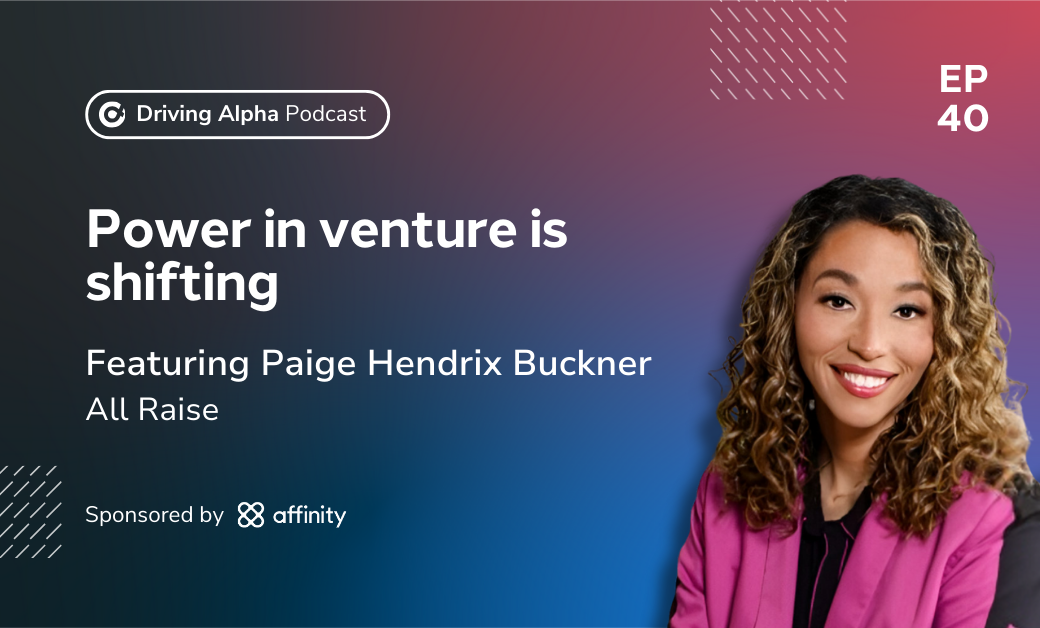
Zoe Van Den Bol: Hello everyone and welcome to the Driving Alpha podcast where we interview top leaders to talk about how they drive alpha for the VC, LP, and entrepreneurial ecosystem. I am thrilled today to be joined by Paige Hendricks Buckner, the CEO of All Raise, a national nonprofit organization focused on propelling forward women and non-binary leaders to move money, shift power, and change culture within the venture capital ecosystem. Her background spans education, public policy, and entrepreneurship, including experience as a Teach for America corps member and training underrepresented founders on securing venture capital. Under her leadership, All Raise is strategically focused on empowering women and non-binary VCs, increasing their measurable power and influence through resources, community, and programs centered around skills, knowledge, and network building. Paige, thank you so much for joining the podcast. Can you please elaborate on your journey, which led you to running All Raise?
Paige Hendrix Buckner: First, Zoe, thank you so much for having me. It’s such a treat to meet you and spend time with you and to have this conversation. I just want to start there. Yes, happy to talk a little bit about my journey. I always say that my journey has been at the intersection of entrepreneurship, education, and public policy, and most of those have been really centered around how to make a big impact on the world and to help people step into their potential. As I look at my journey, I started as a little kid in a really small town in southwest Missouri who really wanted to be out in the world. When I was in high school, I was a competitive speech and debate kid. During that experience, I had the privilege of reading a lot of publications about what was happening domestically and internationally and in all kinds of sectors.
When I got to college, I thought I was going to be an attorney, and that’s what I was really excited to build towards. But it was when I entered Teach for America that I realized I had an opportunity to make an impact in the United States — because I originally wanted to work abroad — and that I could make an impact in the public sector. I went from being a fourth and fifth grade teacher in Las Vegas for three years — which honestly changed my life and what I thought was important — to then working for an elected official. I worked at a nonprofit, the Urban League, to help families get access to healthcare. This was before Medicaid expansion.
Then I got into the startup world thanks to my husband, who was really excited to invite me to a startup weekend. When I attended that experience and we finished in the top three, I realized there was an opportunity to also make a big impact in the world and solve big problems through the private sector and specifically through startups. So I started my own company, got into an incubator, got really involved in the Portland ecosystem where I still live. It was a transformative experience because I learned how to work in shorter sprints and learned in a different way how to design user experiences around our customer — similar to how I would have done that in a classroom for kids, but now as a startup founder.
I made the leap from being a founder to then working for a startup called Founder Gym. That was also a transformative experience because I got to see the power of community in action. While we were trying to train founders on how to raise venture capital, and they did come for the skills and the knowledge, it was the network they walked away with that I think was the most powerful. From Founder Gym, I found out about the opportunity to join All Raise. I first joined as the chief of staff and then stepped into the CEO role the following year. When I stepped into this role, I couldn’t unsee the opportunity because it was a place where I could pull a big lever, make a big impact, and do it through both nonprofits and the private sector.
Zoe Van Den Bol: A lot of interesting, diverse experiences that really led to this moment with All Raise. I want to hone in on what All Raise’s mission is. What are you building toward with the community?
Paige Hendrix Buckner: Our mission is to help women and non-binary investors, founders, and operators be wildly successful. The way we think about doing that is changing both the culture and the composition. Culture refers to the behaviors and norms that venture capital opts into as we think about who can be successful inside of firms and startups. Then we look at composition. We like to measure the metrics that matter in order to help move the needle.
When All Raise first started, there were two metrics we focused on. The first was measuring the number of women and non-binary people in Partner+ roles at U.S.-based VC firms — we were really trying to identify decision-makers. The second metric looked at the amount of capital going to women and non-binary founders at the earliest stages.
Since that time, we’ve really honed in on helping women and non-binary VCs, which I know we’ll talk more about. The logic there is: if we want to change who gets access to capital on the founder side, we have to start with who’s writing checks and making investment decisions in venture capital. That’s where we’ve focused, and I’m really excited about that intentional focus. It allows us to help those folks be successful, and it also allows us to bring LPs into the equation — they’re a really important part of this capital stack. I’m thrilled about the work we’ve already done and excited for the next three, five, ten years to come.
Zoe Van Den Bol: All Raise has been around for some time and since you joined in the chief of staff role and then became CEO, I have to believe you’ve seen so much transformation within the organization and also how women and non-binary folks have evolved within the world of venture capital. Can you give us some of the highlights that the All Raise organization has achieved and what you’ve noticed in terms of how the industry has shifted?
Paige Hendrix Buckner: I want to go back to the metric that we talked about earlier — tracking the percentage of women and non-binary VCs in Partner+ roles. At the beginning of our work, we were tracking approximately 318 people in Partner+ roles. That was 9% of VCs in those roles in the industry. Now, according to PitchBook, we’re at 18.6% of people in Partner+ roles at U.S.-based VC firms. That means we hit our goal of doubling that percentage three years ahead of schedule, which we’re thrilled about.
But there’s more work to do. And we know that for two reasons. Number one: when you dig into that data — and when you talk to people — you realize that title is not the same as power and influence. You can have a title inside a firm, but that doesn’t mean you can get your deals across the finish line. That doesn’t mean you get the best opportunities. So the question we’ve been asking is: how do we help our community members grow their power and influence?
The second piece is that we’ve started looking at metrics of power and influence because we’d like to develop our own. At this time, we’re looking at the percentage of women who lead deals in the industry and the percentage who take board seats after a VC firm invests in a company. Those are sitting around 12% and 13%, respectively.
So if you think about where we are in terms of representation and then look at just some of the indicators that you have power and influence — the ability to lead a deal and to sit on a board — those are just two metrics among many more. They tell us that we have more work to do to help women and non-binary VCs grow their power and influence.
And the reason this matters is because having that influence and power allows you to source and win the best deals that are aligned with your expertise and passions. And we know that when you have mixed-gender teams, you are more successful because you’re seeing deals your partnership may not otherwise see. You can help those companies succeed, get to exits, and bring value back to the firm and to LPs. It’s important because if you don’t have gender-diverse teams with actual power and influence, you won’t see the outcomes that are good for business.
Zoe Van Den Bol: Yes, and we’ll definitely dive into all the metrics and understanding why having diversity within teams and diversity of thought leads to outsized return and positive alpha. But a lot of the listeners to this podcast are investors across the board. Specifically for our women and non-binary investors who are listening, what are some ways you’ve seen them increase their power and influence — within their organizations, and within the broader community?
Paige Hendrix Buckner: I actually think it starts with finding the right firm. You need to find the right place where your expertise — your competitive edge — is respected and leveraged. That’s critical. I mean, that’s like any job, right, Zoe? If you want to really flourish and shine, you need to find the right environment to do that.
So that’s first. Second, you have to find sponsors and mentors. I talk to people every day who share examples of how finding a sponsor changed their career. That person didn’t just give them advice — they helped them navigate firm politics and understand how to turn those dynamics into opportunities.
For example, I was speaking with one woman the other day who didn’t realize that in order to get a deal done, there was a certain way she had to communicate with everyone in the IC to build confidence in the deal. Once someone sat her down and explained how things really work, she was able to be successful. So again, she could start putting points on the board.
Lastly, building your competitive advantage. How are you staying abreast of the best data, insights, and trends? How are you known in the industry? How are you building a reputation so people bring you deals and ideas in your specific vertical?
We recently had this incredible strategy dinner, and there was a junior investor who shared her strategy. She said: “I like to be in places so that people know I’m the right person to bring deals to. One of my personal metrics of success is that I’ve seen all the best deals.” She said, “I can’t make decisions unless I know what’s out there. First, I’ve got to see it. Then I’ve got to have a chance at actually winning it.” And that’s about having knowledge, skills, and a network to bring value to that company — and being able to explain why you’re the right investor for that stage, that sector, that team.
So, to summarize: find the right place to flourish. Find sponsors and mentors who can help you navigate internal politics — and the industry. And build your competitive advantage and make it known.
I’ll also add something special that I’ve noticed All Raisers do really well: they’re incredibly relational. They build dinner series, groups that gather regularly to share insights on a specific sector. That’s how you get intel and build trust — which leads to deal flow, influence, and everything else.
Zoe Van Den Bol: Let’s start backwards — or, well, last to first. I really want to drill in on some of these points because I think this is valuable for investors across the board. So, when it comes to building your competitive advantage: yes, I understand you want to be in the right place at the right time, and we always talk about “find your superpower” — that’s going to make you stand out because this is a very autonomous job. The quality of your work is dependent on getting the right access, the right information, and it’s all private information. So you need to find your unique ways to get it.
When you think about — and what you’ve seen with All Raisers and investors across the board — people trying to build out their competitive edge, I know you mentioned networking and knowledge, but what are some specific examples that have worked really well? And do you have any advice on how someone can discover what their superpower is — something that will accelerate them to the next step?
Paige Hendrix Buckner: When you’re thinking about building out your competitive edge, the question you need to ask is: what is the thing I’m most interested in continuing to pursue — something I’ll go down the rabbit hole on? For me, the word is curiosity. Where are you most curious? Because that will sustain you even when things get tough — when you see other people winning deals. I had a conversation with someone who said, “Man, there’s nothing like losing a deal. It feels horrible, and you forget all the good things that have happened.” So how do you stay in the game? Curiosity is key.
Once you’ve assessed that curiosity, you need to show it to other people. Here are a few tactics: internally, be the person who’s constantly surfacing new data, insights, experts, and opportunities that are tied to your area of curiosity. Let people know, “This is the thing I know better than anyone else in the firm.” When a deal in that area comes across the desk, they’ll think of you.
Externally, speak publicly. Start a podcast. I’ve seen incredible investors leverage platforms to build thought leadership. When I was a founder, I used public speaking to reach customers and build our reputation. VCs can do the same — speak, write, publish — position yourself in your domain of expertise.
You also want to build a reputation so people are talking about you even when you’re not in the room. That means building relationships with peers, people ahead of you, and people coming up behind you. Relationships lead to trust, and trust leads to opportunities. That’s a big part of the All Raise community: give and get. We want people to show up and offer value, but also walk away with something meaningful in return.
And finally, be more transactional. I hear this a lot: specifically women and non-binary folks often build connections based on shared experiences and personal check-ins. That’s great — but we also need to be transactional. Share deals. Share LP info. Help people get on panels or podcasts. Recommend them to journalists. Being transactional builds track records and gets results. And that’s how we shift power and build alpha.
Zoe Van Den Bol: That whole conversation about how transactional relationships should be — I feel like that’s, maybe not controversial, but it’s debated a lot. You don’t want to be too transactional because it can be hard to build real relationships. But sometimes we fall into the trap of “this is my friend” — and then we’re hesitant to ask for anything.
But we have to realize: at the end of the day, this is business. We’re building relationships because we need to find and invest in the best deals and lift each other up. I actually just had this experience the other day — not with a VC, but with a friend from college. She called me and we were talking about deals. She works in wealth management. We made intros for each other and she said, “Isn’t this great? That we can help each other professionally and personally?” And I thought, “Yes — this is the epitome of a great friendship and great relationship.”
We all want to help each other, but just to give a bit of context for the audience — I host these monthly women in VC dinners. That’s kind of my superpower: bringing investors together. I’m fortunate to be in a position to network with brilliant investors and bring them together. And yes, they become my friends — it’s in my apartment, I cook for everyone — but it’s also about sharing deals.
The KPI I care about is: did you co-invest afterward? Did you start a conversation? Were you helpful to each other? That’s how I know it’s working. And I think we should be having more conversations about that. It’s what makes All Raise such a great community too — it emphasizes both: relationships and results.
Paige Hendrix Buckner: I could not amen that enough, Zoe. I want to call out that friendship example — thank you for sharing that. I couldn’t agree more. How incredible is it when you get to do work with your friends? It’s wonderful because you’ve built trust in one area, and now you get to leverage that trust professionally. That’s another dimension.
And I want to remind everyone: your friends want you to win, and you want your friends to win. This is a clear opportunity to make that happen. One of the things I love in my role is being a connector and a cheerleader for others — hearing about what people are doing, then talking about them in rooms they’re not in, so I can connect them to the right resource.
Someone reminded me of this last night. I’ve had an opportunity to connect with one of my personal heroes, potentially work with them. And someone on their team said, “You should let them know that.” So we should let each other know when something happens because of a Zoe dinner. Let her know that this connection led to a deal. And also, Zoe — love what you’re doing, and everyone: tell her it’s working.
Zoe Van Den Bol: I appreciate it. And I really want to highlight the whole sponsor-mentor side of things, because everyone says venture is an apprenticeship job. But being a junior in venture has changed over time. It’s less like the old model where one GP works hand-in-hand with one associate. Even though funds are still small, they’ve also grown, and there are so many more funds now. The dynamics have shifted.
You don’t have a formal analyst program where you’re trained up and go through the motions. It’s a very autonomous role where you really need to build your own track record, but there’s no guidebook. Every firm is unique.
So I understand — we all know we need sponsors to help us grow. But you, being in the CEO seat at All Raise, really understand the importance of mentorship. That’s what you’re building programs around. So how are you seeing people find those sponsors? Whether internal or external? And what are the best strategies for junior women and non-binary folks at these firms to find those advocates — those mentors — who will help them get to that next level?
Paige Hendrix Buckner: Sponsorship, in my experience, makes or breaks people’s careers. That’s a very serious statement, but in venture capital — because it’s an apprenticeship business — other people have to show you the way. They have to teach you the social norms.
Let’s start internally and then go to externally. Internally, having a sponsor who understands your expertise, who sees your potential, who is willing to speak highly of you when you’re not in the room, and who’s willing to keep it real with you when something hasn’t gone well — that’s crucial. Candor is such an important part of sponsorship. It’s about helping someone step into their potential.
In venture capital, to me, sponsorship looks like: someone brings you into the firm, takes you under their wing, and helps you succeed. I’ve heard of firms that actually operationalize multiple sponsors for that very reason — so you’re not left without a champion if one person leaves. That’s a great model. It takes a village to grow a successful VC. Even though venture is often a lonely sport, it’s also deeply relational — and your sponsor is one of the key players in that.
Mentorship is different. It’s more like: “I’m here when you need me. I care about you. I want to help you.” But sponsorship is more intense — more day-to-day. Especially internally, that sponsor is often someone you work with regularly — they know your deals, they know how you think, and they help you navigate the internal structure.
Externally, you can also have sponsors. It’s just a different flavor. I often think about external sponsors as people who aren’t working in your firm’s best interest — they’re working in your best interest. They may want to collaborate, share deals, maybe even hire you one day.
For both internal and external, it comes back to your goals. What are you trying to achieve? What are you trying to learn? And what value can you bring to that relationship? Because these relationships should be a give and a get.
Internally, it’s often the person who hired you. But it could also be someone else on the leadership team who says, “Hey, I want to help you grow.” Be proactive. Seek those people out. One junior investor I spoke with said she intentionally studies the partners she wants to work closely with. She’ll ask to shadow them in board meetings or pitch calls — not just to see what they do, but to understand how they do it. And she always makes sure to follow up and debrief afterward. That builds trust.
Externally, I’d say the same thing applies. Think about where you want to go in your career. Who’s doing what you want to do in five years? Ten years? Who do you admire — and how can you learn from them? Having both internal and external sponsors gives you options and perspective.
Zoe Van Den Bol: Got it. I understand it’s a little bit easier to identify the internal mentor. But when it comes to external sponsors — especially for junior investors — what’s the best approach to find the right person? And since it’s a give-and-get, how can someone earlier in their career offer value to someone more senior who’s taking the time to invest in them?
Paige Hendrix Buckner: I firmly believe that more junior people don’t always appreciate how much value they actually bring. And there are two things I’ve been thinking about.
First, when I interview more senior investors — men, women, non-binary folks — they often say: “I wish people would ask me more.” They want to be asked to mentor. They want people to reach out with a clear ask. Not just “loved your talk,” but “Can I get 15 minutes? I’d love to get your perspective on something I’m seeing in the market.” People love to be useful.
I’ve heard this specifically from participants in our VC Champions program. These are experienced GPs who volunteer to mentor two to four folks each year. Several of them have told me, “Please tell my mentees to follow up! I want to hear how they’re doing. I want to support them.”
Second — junior people often have access to really interesting deal flow. That’s valuable! You might be closer to the founder community. You might be more active in a specific niche or geography. So if you’re seeing great stuff — say something! Reach out and say, “Hey, I’ve been tracking these deals. I’d love to get your take on them.” That’s a real value exchange.
Finally, if someone resonates with you — maybe you saw them speak or read something they wrote — reach out. There’s something about them that’s calling you in. Follow that curiosity. They may not respond the first time, or the second time. But that doesn’t mean the door is closed forever. Just stay authentic, and follow up when it’s timely.
Zoe Van Den Bol: That’s some great advice, and I’ll echo that from personal experience. I work with a lot of GPs, and sometimes I feel nervous talking to them because I think, “What do I know? What’s my value here?” They’re so much more accomplished, and I’m still figuring things out. But what’s interesting about venture is that it’s often the junior folks who are on the ground — talking to founders, doing the research. You have a lot of real-time insight to share.
Especially with things like AI — younger generations are often the first to pick up and test new tools. That knowledge is valuable. So please, don’t hesitate to reach out and find a mentor. I personally mentor a lot of students from NYU, and I’m always happy to jump on a call and share what I know. Just ask.
Now, we mentioned earlier — and I want to dive deeper into this — the network-building part of All Raise. I’m personally in the Associate Cohort program and I’m really enjoying that. You also have the VC Summit. Can you talk a bit more about how All Raise helps investors build their networks? And what’s the importance of building these networks within the various communities you provide?
Paige Hendrix Buckner: All Raise was really rooted in network and community from the very beginning. We’ve worked to codify that in ways that allow people to engage more intentionally.
So we have a few core engagement areas. First is membership — which is free. When you become a member, you can see where other members are located, what stage and sector they work in, and more. That way, you can reach out and say, “Hey, I noticed you’re in the same city,” or “I’d love to connect on X.” It’s a great starting point to build real relationships.
Second is our VC Summit — our flagship annual event. At the time we’re recording this, our 2023 Summit is next week in Half Moon Bay, California. It’s designed to be fun, intimate, and packed with learning. We lean heavily into breakout sessions so people can learn from each other — not just from the stage. And there’s space for connection before, during, and after the event. I’ve even heard folks are sticking around for extra days to keep meeting up!
Third, we run cohorts year-round. These are based on job title — Associates, Principals, and Partner+ levels. Each cohort is a small group with curated programming and a mix of workshops, in-person breakfasts, and opportunities to travel and meet. It’s all about deepening those long-term relationships. And I know folks are flying to meet their cohort-mates, which I love.
Finally, our Champions Program is about mentorship and sponsorship. It pairs experienced GPs with emerging managers and Principals. It’s built on the apprenticeship model — helping people grow through deep, trusted relationships outside of their firm.
Next year, we’re dialing in even more. We want our programming to tie directly to the outcomes that matter — like putting points on the board. Whether that’s DPI, leading a deal, joining a board, or getting promoted — we want to support those outcomes with clear, measurable tools.
Zoe Van Den Bol: One of the things we’ve talked about before with All Raise is the strategy of building an engine around “lore” — the story around the investor. And that’s more than just, “Here’s my role.” It’s: “These are the deals I’ve done. I’m an expert in this space. Come to me for this. This is my edge.”
What have you seen in terms of the power of storytelling — especially for women and non-binary investors in VC? And how is All Raise helping people craft and amplify their stories?
Paige Hendrix Buckner: Lore shapes who we believe can be successful in venture capital. So I want to start there. Over time, I’ve learned that the story is everything — especially in VC. It’s how founders pitch. It’s how investors pitch LPs. It’s how firms pitch deals internally. It’s all narrative.
The story is what brings us together around a shared belief in what’s possible — and that applies to both founders and VCs. For founders, it’s about what they’re building. For VCs, it’s about what they’re backing and why.
Over time, that story becomes your reputation. It shapes your ability to lead deals, take board seats, and build trust with LPs. And it also impacts how you show up in the market — how others talk about you and think of you.
All Raise wants to help members build and amplify that story. So what does that look like?
First, we work to get people speaking opportunities — podcasts, panels, interviews. We want them in places where their expertise can shine.
Second, we feature them in our own programming — whether that’s moderating at the VC Summit, leading a breakout, or hosting their own event. It’s a chance to showcase what they know and how they think.
Third, we help them get media exposure — from live TV to top-tier publications. Whether it’s insights on a sector or a deal, we want them to be quoted, featured, and seen as thought leaders.
Ultimately, it’s not enough to do the work. People need to see the work. And when others see you as successful — that changes the lore. That makes space for more people to follow in your footsteps. Lore is power.
Zoe Van Den Bol: Yes, I definitely appreciate the fact that we should give credit to the investors where credit is due. Now, I want to make sure we’re really emphasizing the importance of why it matters to have diverse teams, and why programs like All Raise are incredibly impactful — not just from an equity lens, but from a returns perspective.
Look, we’re on the Driving Alpha podcast. We need to discuss how we realize positive alpha. So in what scenarios does diversity lead to outsized returns?
Paige Hendrix Buckner: First, I want to remind people that this work is important because it’s good for everyone. There’s a narrative out there — not just in venture, but across business — that diversity means giving one group an advantage at the expense of another. That’s not the point.
The point is: we want more perspectives on the team. That helps us avoid risk. It helps us see opportunities that might otherwise get missed. It brings unique lived experiences that actually help build better value for companies.
And there’s strong data to back this up. We know that VC firms that hire just 10% more women partners see 1.5% higher returns and 9.7% more profitable exits. Gender-diverse teams are 25% more likely to outperform. Firms with women in executive positions significantly outperform those with fewer women at that level.
So, again — this isn’t about excluding anyone. It’s about growing the pie. It’s about building better teams that make better decisions and win more often.
There’s also a great body of work on the great wealth transfer — and how women are positioned to become key economic drivers over the next decade. One of my favorite takeaways from that research is this: increasing women’s prosperity doesn’t shrink opportunity for others. It expands it — because it grows the total amount of wealth, opportunity, and innovation.
So when we talk about diversity in VC, we’re not talking about tokenism. We’re talking about unlocking massive value for firms, for founders, and for the entire industry.
Zoe Van Den Bol: I think those are some really impactful points — especially in a time where the conversation is shifting, and people are re-evaluating how we define merit and outcomes.
We need to look at the data. And yes — multiple studies show that diverse teams with different perspectives lead to better returns. Especially in venture, where you’re supposed to uncover the non-obvious — that’s where you find alpha. You need people who can see things differently, who understand different markets, and who have the conviction to back founders building for a better future.
So thank you for those points. Paige, this has been a great conversation. I know we’re running up on time, but I want to leave the floor open if there’s anything else you want to share with the audience.
Paige Hendrix Buckner: First, I’d love to have people come check us out at allraise.org. We’re an organization that’s excited to bring women, non-binary folks, and men into the conversation — because we want to build a venture ecosystem that’s inclusive, diverse, and built to last.
Second, I just want to remind everyone that in this time of massive change — especially with AI on the rise — relationships are more important than ever. Building trust, getting to know people, understanding their superpowers and supporting their success… that’s going to matter more than ever.
Whether someone’s inside your firm, outside your firm, ahead of you, shoulder-to-shoulder with you, or coming up behind you — community can be your competitive advantage.
Zoe, what you’re doing with your dinners is a great example of that. And I’d encourage everyone to add that communal element to your own strategy. Because I do think it’s a critical edge, and it will continue to be for decades to come.
Zoe Van Den Bol: That’s some great wisdom to end on. Thank you so much, Paige.
Paige Hendrix Buckner: Thank you, Zoe.