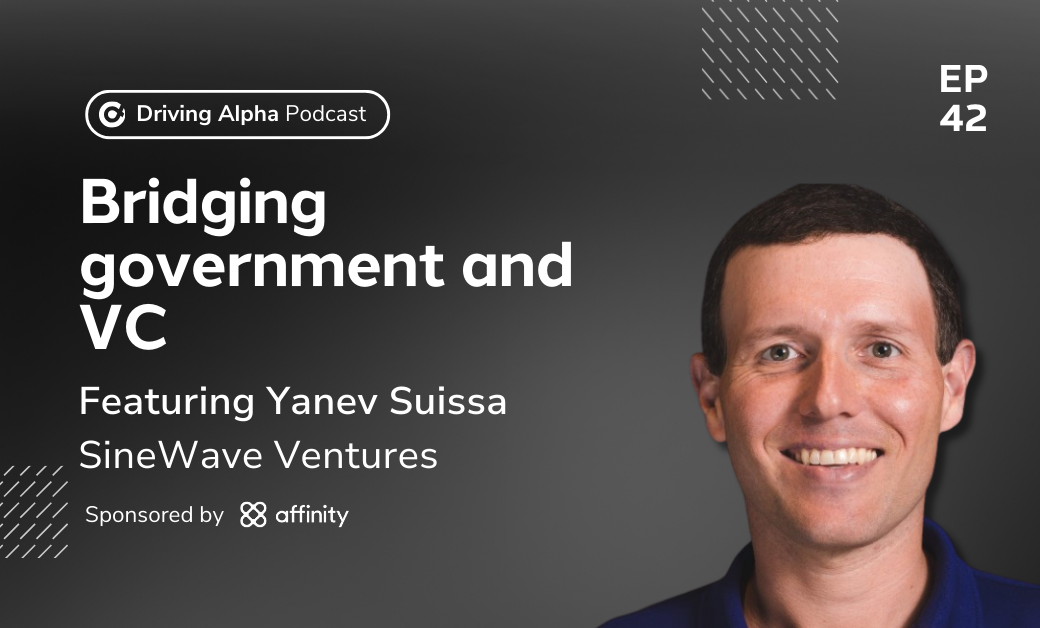
Oliver Henry: Welcome everyone. My name is Oliver Henry from Alpha Partners on Driving Alpha, where we interview top VCs about how they are driving alpha for their LPs, for fellow investors, and for the companies they work with. I’m very fortunate to have Yanev Suissa from SineWave Ventures with me today. Yanev is a remarkable investor. Prior to SineWave, he was at NEA for a number of years. He also served under the Bush and Obama administrations and has invested in companies like SentinelOne, Evolv Technology, Jump, Databricks, and many more. Yanev, thanks for joining the pod.
Yanev Suissa: It’s great to see you, Oliver. I’m excited to chat.
Oliver: Awesome. I gave a brief overview, but I’d love to hear more from you—what you invest in, your thesis, and your professional story.
Yanev: Sure. If I were advising someone on how to get into venture, I would not tell them to do what I did. It was definitely a different route. I’m way overeducated, and I had a lot of debt for a long time. But the most relevant thing to venture was that I was an entrepreneur. Then I became a senior guy under both the Bush and Obama administrations. We had billions of dollars to invest directly in new technologies. That was everything from Series B venture all the way to multi-billion-dollar project financings. So it was all direct investing, which is very unusual for the government.
Then I was recruited by NEA. Back then, the recession was actually the best thing that ever happened to me because everyone wanted access to capital. That experience is actually a big part of the thesis behind SineWave. So I was at NEA for many years doing early-stage enterprise investing and realized that I was the only senior government person at any of the top venture funds. That gave me a swim lane other people hadn’t seen.
I noticed that many of our commercial companies were going public with 20–30% of their revenue coming from the public sector. We define “public sector” pretty broadly. I was able to help those companies win that revenue. So we created SineWave to fill that gap. We’re not tied to defense; we only do commercial technologies. I always say baby Microsofts, not baby Lockheeds.
Oliver: That strategy’s clearly working, considering your portfolio. There’s a big rush into government tech lately with players like Palantir. When a space gets hot, it often burns people. How do you approach the market? And what advice would you give others?
Yanev: I wouldn’t say people shouldn’t try it. Innovation is good. But there’s a difference between understanding how government works and actually delivering a $20 million contract to a startup.
You see folks from government who want to be in venture but don’t understand startups. And you see VCs who think that hanging out with politicals or being a military vet is enough to sell to government. Those things are admirable. But in reality, it’s the GS-13 who controls a billion-dollar budget and doesn’t have a LinkedIn profile who decides who gets the contract. That’s who we know. That’s where we win.
Oliver: This podcast is about driving alpha. How do you deliver alpha to your founders? And how do you win deals in this environment?
Yanev: We’re not trying to build a better Sequoia than Sequoia. They’re already great. What we try to be is something different. We’ll lead deals, and we do lead most of our deals, but we don’t need to lead. Founders view us as strategic.
We open markets. During diligence—or even before a raise—we’ll introduce the company to potential government and commercial customers. So even before we’re in the deal, we’re showing value. That’s powerful.
Oliver: You came from NEA. Now you’re competing with megafunds like Sequoia and Andreessen. How do you see the landscape changing?
Yanev: You don’t have to compete with those funds directly, but you have to understand the ecosystem they operate in. They’re not really venture funds anymore; they’re asset managers. They’re managing capital for pension funds and want 10–12% returns. So they’re essentially index funds. They place lots of bets and hope one of them turns into a Facebook.
We’re in the business of being investors, not just investing. That means concentration. That means conviction. We do about 15 companies per fund. We have strong opinions, form theses, and make concentrated bets. And we’re okay being wrong sometimes, but we’re trying to outperform, not just return the fund.
Oliver: Let’s talk about how you make decisions. How do you source, diligence, and make calls as a team?
Yanev: We’re more hunters than gatherers. We form theses, and then go out and find companies that match them. Each member of the team brings a different angle—technical, commercial, public sector. We do five to six deals a year, and we do them as a team.
We introduce companies to customers before we invest to make sure there’s real demand. Then we ask: can this team build something big? Can they scale it? Can they hire? Do they have grit? Are they aligned with us?
Oliver: Speaking of grit, how do you evaluate it? Especially in founders you don’t know?
Yanev: The best is when you have repeat founders. But when you don’t, it comes down to how they handle the hard stuff—valuation, criticism, gaps in the product. We’re very transparent. Some of my partners are blunt, others more diplomatic. But we get to know founders before the raise, so we have time to see how they think and work.
Persistence really matters. Most of the companies that succeed just kept going when others would’ve quit.
Oliver: Let’s shift to AI. Everyone’s talking about it. How do you think about AI as an investor?
Yanev: Our biggest advantage is being based in D.C. Most of our companies are still in the Valley, but we’re not in the hype bubble. So we ask: is this solving a real problem, right now?
A lot of these AI tools are just that—tools. If you’re selling to a company that doesn’t have AI engineers, you’re not solving anything. We look for contextual AI—AI that understands the problem, fits into the workflow, and delivers ROI immediately.
Oliver: Some folks say a few big players will own AI infrastructure. Others say there’s room for tons of vertical winners. Where do you stand?
Yanev: I don’t think there will be just one winner. Look at cloud: AWS and Azure run the backend, then you have Databricks and Snowflake on top, and then apps on top of that. AI will follow the same stack.
There will be a few foundation models, then dozens or hundreds of vertical applications built on top. The trick is picking the companies that can own their vertical and then expand horizontally—just like Databricks did.
Oliver: Founders often complain about their VCs. How do you avoid being one of those VCs?
Yanev: It’s about mindset. There are some jerky VCs, but I think a lot of friction comes from founders being trained to see VCs as adversaries.
We’re on the same team. After we invest, we want the same outcome. We’re not trying to run your business, but we can help. Share your pipeline with us. Let us make introductions. Use us as a sounding board. That’s where the value is.
Oliver: What’s the best part of being a VC? And what’s the worst?
Yanev: Best part is helping people build amazing things. Getting to be around people smarter than me all the time. And building the team at SineWave—that’s been incredibly fulfilling.
Worst part is you don’t control the outcome. You’re not the one driving. Also, fundraising is painful. But I love what I do.
Oliver: Final question: what’s the best advice you’ve ever received?
Yanev: Two things. First, you live multiple lives in one lifetime, and not everyone fits in each of those lives. And second, get on a train. Don’t just sit on the platform. You can always switch trains later, but keep moving.
Oliver: I love that. Thanks so much, Yanev. This was awesome.
Yanev: Thanks, Oliver. Great conversation.