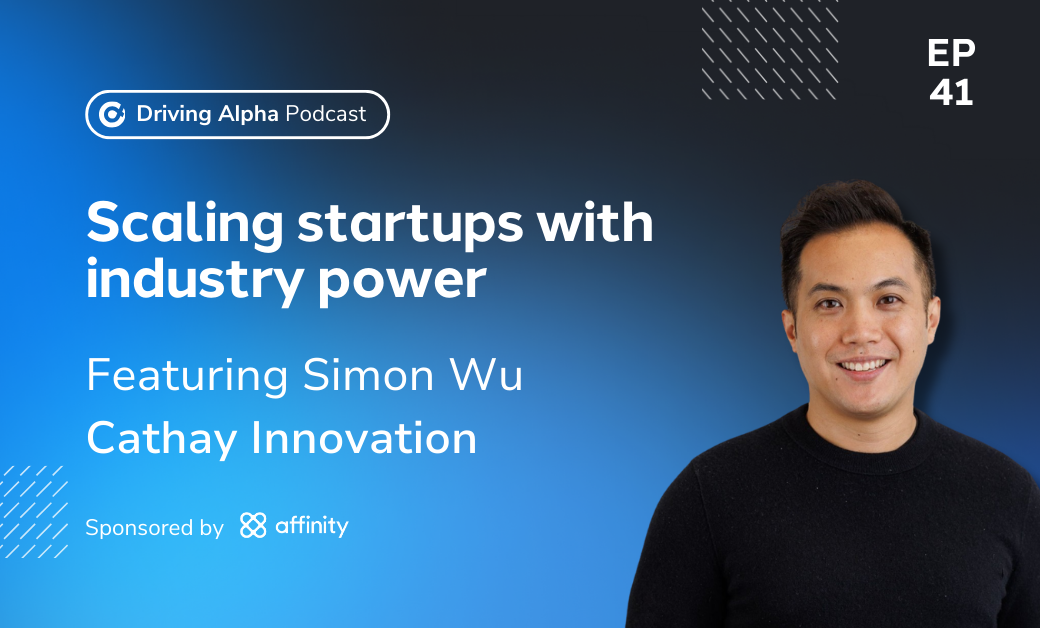
Brian Smiga: Hi, this is Brian Smiga, co-founding partner at Alpha Partners. Alpha Partners is the VC’s Growth Fund. We partner with early-stage VCs to assist them in filling their prorata in their best companies. Driving Alpha Podcast is about how great managers and great funds like Cathay Innovation drive returns. I’m so happy to have you on our show today, Simon Wu. Nice to see you.
Simon Wu: Brian, great to be here. Thanks. You too.
Brian Smiga: Absolutely. Gosh, I first met your partner Denny Barry in 2017 at a breakfast we co-led with Atta Capital. We do these breakfasts every quarter in San Francisco and New York to meet other VCs. Soon thereafter, I met you, and the firm has just grown so much in those eight years. Tell me—what’s the origin story of Cathay Innovation? What was it created to do?
Simon Wu: Absolutely, Brian. Thank you again for having me. It was really nice to be part of that breakfast. Your series has been one of the highlights of Silicon Valley gatherings. I look forward to co-hosting one with you and the team again.
As for the origin story—while the name “Cathay Innovation” might sound like an airline or a bank, we are part of a larger asset management group. For your audience and founders out there, as much as I’d love to get you first-class tickets, that’s not us. We’re actually a Paris-based firm that started as a private equity firm, Cathay Capital, back in the early 2000s. It was spearheaded by Ming-Po Cai, our founder and chairman.
Ming-Po was an immigrant from China who came to France as an entrepreneur. He built a very successful business, sold it, and wanted to help founders in Europe expand into the rest of the world. He believed that his cross-border roots and cultural fluency could really help entrepreneurs go global. So he started a private equity firm using some of his first fund capital to do exactly that. Over time, it grew into a platform with over 150 people across eight continents and nearly $8 billion in assets under management over the past 20 years.
On the venture side—where I work—we got started in 2015, when Denny and Ming-Po met. Denny came from a corporate background. He was a researcher in quantum dots and later worked with a number of corporate VCs, helping corporates scale their startup programs, most recently at Publicis and Orange.
That blend—of entrepreneurial grit and corporate experience—is what makes Cathay Innovation unique. They believed having an industrial base and a deep understanding of how large companies could help founders was a huge advantage. At the same time, they knew large companies and young startups operate at very different speeds, so translating between those two was key. That translation layer is something we’ve leaned into, especially as tech continues to disrupt industrial players.
I joined as the first hire to build out the San Francisco office with Denny. We launched the venture side of the business in 2015. Out of the broader Cathay platform, we manage about $2.5 billion on the venture side. Our first fund was $300 million, anchored by European industrial LPs. We also brought in traditional institutional capital, but we knew from the beginning that our strength came from the ability to open doors with deep relationships—because those corporates were LPs in the fund.
Our team came from diverse but aligned backgrounds—Denny, with his corporate innovation experience; Ming-Po, as an entrepreneur; I came from VMware, investing off balance sheet; Jackie, one of my partners, came from Zendesk; and Nicolas, another partner, also came from a corporate background. We built a team that understands how to connect founders with decision-makers inside large enterprises.
We got very lucky in Fund I. That $300 million fund included early investments in Didi, Chime, and Momentum (a self-driving company), and we also backed Glovo, which was acquired for a couple billion. We raised Fund II—a $650 million fund—in 2019. Then, earlier this summer, we closed our third fund at $1 billion.
Brian Smiga: A billion dollars—congratulations. That’s what we all aspire to. We’re on our way at Alpha, but you beat us to it. That’s a rapid rise. What I think really sets your fund apart is that it was founded by a scrappy immigrant entrepreneur who built a global private equity firm and then launched Cathay Innovation as the venture arm. And now you’ve raised your first billion-dollar venture fund.
What also stands out is the corporate connection—the ability to scale your companies by unlocking customers and business through corporate relationships. That’s unique. Can you expand on that? Name some names? Give an example?
Simon Wu: Absolutely. We started Fund I with seven corporates. On one end, we had industrial companies like Valeo—a tier-one automotive supplier. We also had Groupe SEB, which is like the French equivalent of Black & Decker, focused on home kitchen appliances. More recently, we added healthcare with Sanofi, and on the consumer side, brands like L’Oréal and Michelin. In energy and mobility, we have Total.
These are major verticals—industrials that represent significant GDP globally. And that’s before even mentioning banks like BNP Paribas or insurance firms that are also LPs. These industrial verticals are particularly interesting now because applied AI is finally reaching them in meaningful ways.
We’re headquartered in Paris, but these are multinational companies. So we’ve built a global presence—offices in Berlin, Madrid, Singapore, China, Latin America, Africa, and more. This allows us to understand local needs and share those insights with corporates and founders.
A company like Valeo, for instance, might be dealing with mining operations in Latin America and seeing something entirely different in Asia. That kind of global perspective is powerful. Our role is to compare notes across markets—to see what’s catching up in Asia or Europe—and bring that knowledge to founders. That’s how we create value.
We also have an ecosystem team that works directly with these corporates and with founders to connect the dots. That’s a major part of how we help startups grow.
Brian Smiga: You’ve got over 200 corporate relationships globally. Maybe only 20 are LPs in your funds, but you have hundreds more in your ecosystem. You’re probably best-in-class at finding companies where there’s a real corporate opportunity to scale. So how do you pitch a corporation? If you’re talking to a new Global 2000 company, how do you explain why they should work with Cathay Innovation?
Simon Wu: Great question. To even be part of the conversation, you have to be top-tier. Fortunately, Fund I ranked as a top 5% fund on Cambridge Associates. Returns get you in the door—but what really matters to corporates is the long-term value.
Most of these companies have internal CVCs and teams investing off their balance sheets. But those teams tend to find incremental improvements. What they want from us is their “Uber moment”—the disruptive thing that changes their business model over the next five years. For that, they need an external partner they can trust.
We’re able to be that partner because Ming-Po and Denny have relationships at the most senior levels—founders, families, CEOs—and also know the operational teams on the ground: GMs, department heads, innovation leads. That alignment between the C-suite and execution layer is what makes partnerships work.
Let me give you an example: we backed Glovo, the delivery company. Pernod Ricard—a huge global spirits company—wasn’t doing delivery at all. It seems obvious now, but at the time it wasn’t. We helped them connect with Glovo, tender the RFP, and position them to win that business. That launched a new division at Pernod Ricard. That’s the kind of corporate-startup collaboration that we specialize in.
Brian Smiga: You’re in the center of San Francisco, South of Market—I’ve been to your office—so you’re at ground zero for the biggest venture ecosystem in the world. But you invest in companies globally. How does Simon Wu “cut the herd” on companies as they come across your threshold? What’s your personal way of quickly deciding where to spend your time?
Simon Wu: Great question. It ties back to what we discussed earlier—positioning ourselves to add value for corporates. We can’t be everything to everybody. Like I say, you can’t outshoot Steph Curry in a three-point contest.
We like companies that already have a product, a couple of customers, and a business model that’s showing some distribution. That’s often the point where our corporate partners can start working with them. Not all our portfolio companies engage with our corporate LPs, but the ones that do tend to benefit from early traction and real business activity.
Corporate partners don’t always have the patience to co-incubate something for years—they’re looking for something they can act on now. So, especially in the current AI-driven market where there’s a lot of noise, I focus on usage. That’s what really excites me.
If customers are actually using the product, that’s a sign of product-market fit. Growth tells you one thing—but retention tells you a lot more. Ultimately, it comes down to trusting the team. The numbers are great for checking boxes, but you have to believe the team can turn that early usage into a durable business model and navigate the messy middle.
It sounds obvious, but when you zoom out and compare globally—especially in AI, where many teams are working on similar problems—the winners often come down to who has real distribution, who customers trust, and who can execute. That’s where our corporate relationships help validate the opportunity.
Brian Smiga: Sounds like it’s the numbers on one side—unit economics, growth, usage—and people on the other. Especially the founder’s ability to articulate what the customer is getting from the product. So what advice do you have for founders on how to build trust with an investor like you?
Simon Wu: We talk to our corporate LPs every quarter. We have a dedicated ecosystem team in each geography that understands their roadmaps and pain points. At the same time, we’re on the ground in Silicon Valley, Paris, and other major hubs, seeing the earliest-stage innovation.
So when a founder connects with us early, we can often share their story across our ecosystem. If you’re looking for a few design partners or enterprise logos to work with, we can open those doors. That helps us show how hard we’ll work for our founders—and it helps founders showcase what makes them special.
We also have a large portfolio on the private equity side across verticals like fintech, digital health, consumer commerce, industrial supply chain, deep tech, and vertical SaaS. That means our own portfolio companies can become customers for startups at the right stage.
If you have early signal that your product has product-market fit, we can help you get that into motion.
Brian Smiga: You mentioned five sectors earlier. AI is intersecting with all of them. So what are some of the most interesting AI opportunities you’re seeing right now?
Simon Wu: What’s exciting is the shift in buying behavior. Historically, it would take a long time for enterprises to go through procurement cycles. Now we’re seeing budgets available, faster security clearance, and more willingness to move quickly. That’s where our ecosystem team is helping a lot.
For example, we have a company called Skan. It’s in process intelligence and sells into banks, insurance firms, and healthcare companies. It builds a knowledge graph of how people work and identifies the areas most ripe for automation.
What’s powerful is that we can help them navigate the full enterprise sales process—from identifying the right champion to getting through paperwork, to closing seven- or eight-figure contracts. We’re even seeing these deals expand and renew rapidly. That gives us real-time insight into what pain points are resonating and which sectors are moving.
That intelligence makes us better investors. We know which problems are urgent and which startups are gaining traction.
Brian Smiga: Let’s look at another example—Range AI in wealth tech. This was another defining moment. How did that play out?
Simon Wu: Wealth tech is interesting because it’s historically been very slow-moving. It’s heavily relationship-driven and human-led. But we believed AI and automation could open up access, improve NPS, and make the economics work better.
So in Fund III, we led the Series B in Range. We had conviction that this was a category-defining company. There was a long-term relationship model, but the tech hadn’t been democratized. Range changed that.
We also validated the thesis with BNP Paribas, which has a massive asset management arm, and with some of our insurance LPs globally. The feedback we got informed our investment decision. It’s turned out to be an early U.S. winner—they just raised a strong round last week.
Brian Smiga: And were you able to follow on in those deals—Range, Skan?
Simon Wu: Yes, we were early investors—both companies were still in the single-digit valuation range when we got involved. We had a thematic view, wrote early checks, and were able to put more capital to work in follow-ons.
Our strategy includes keeping large reserves for just that reason. We aim to earn our way into super pro rata positions. And in both of those cases, the founders appreciated the value we added and gave us that opportunity.
Brian Smiga: With a billion-dollar fund, can you get enough money into each of the companies in your next portfolio?
Simon Wu: That’s definitely a challenge. We’re seeing a lot of funds bend their historical rules on ownership just to get into the best companies. Competition is fierce.
But for the founders where we can deliver value, we’ve been able to scale up our ownership—starting with single digits or low double digits and growing into higher double digits. We also bring in LPs and other partners for co-investments in larger rounds.
Brian Smiga: That’s great. You’re unusual in how you stick with companies—coming in early, following on, and helping them scale through corporate relationships. How do you work with other VCs? Clearly, you’re co-investing with some of the best in Silicon Valley and around the world. What do you bring to the table in those syndicates?
Simon Wu: Absolutely. The best founders don’t lack capital. And they already have name-brand firms on their cap tables in seed or Series A rounds. What they’re looking for are partners who operate at the same speed—but who also bring something different.
We offer that difference. We don’t have sharp elbows. We’re often the second-largest check, we’re flexible on ownership, we move fast, and we deliver value early—whether that’s hiring, customer intros, or international expansion.
Our case studies and founder references reflect that. We can’t be everything to everyone, but when we lean in, we create win-win scenarios. One plus one equals three.
Brian Smiga: That shows up in your culture—starting with the founder in Paris who built something from nothing, to a global platform helping others scale. I’ve known you for years, Simon, and you’ve always been a kind, thoughtful player in this space. That stands out in a competitive environment.
So tell us—what’s going to surprise us in 2026 or 2027?
Simon Wu: Everyone’s asking if we’re in an AI bubble. My hot take is that by next year, no one will call AI companies “AI companies” anymore—they’ll just be tech companies. Everyone will be using AI.
Markets will bifurcate. Right now, all AI companies want to be valued the same—but that won’t last. The companies with real moats—data advantages, distribution power, proprietary models—will be valued as “N of 1s.” Multiples will stretch accordingly.
Series A will get harder. Series B will be the hardest. Investors will already have made their bets, and they won’t back a second player in the same space without something extraordinary. Concentration will increase. In the Valley, 10 or so funds already dominate the majority of rounds.
Founders who thought they had the easy mode—coming out of YC or raising a hot seed—will find it a lot harder at Series B.
Brian Smiga: How will Cathay Innovation adjust? Will you come in earlier? Change your strategy?
Simon Wu: Great question. Everyone’s reflecting on this right now. As investors, we’re asking—are we doing the best we can for our founders?
We’ve spent a lot of time chasing “king-making” rounds, but we also want to help our companies grow into their valuations. The landscape has shifted. What used to be a Series B valuation is now a seed or Series A valuation.
Fund size dictates strategy. Even with a billion-dollar fund, our check sizes range from a couple million up to $40 million—but today that still means we’re largely a Series A firm.
Beezer Clarkson had a great podcast recently, talking about how $500 million is really a seed fund, and anything over $750 million is an A fund. That’s how we think about it too. We’re in the A-to-B strategy zone now, which is different than it used to be.
Brian Smiga: So you’re a defining moment VC. You back companies at inflection points—and help them scale into corporations, cross-border markets, and strategic outcomes. That’s a great way to put a bow on it.
Anything you want to say in closing? Are you ready for the holidays?
Simon Wu: I’m excited to probably do another deal with you guys very soon. Alpha Partners has been amazing co-investors with us—and the founders appreciate it too. So yes, I’m ready for the holidays, and I’m looking forward to teaming up again.
Brian Smiga: We just opened Alpha Israel, so if you’re investing there, let’s team up. We’re also following on in companies you backed in earlier funds, and we share profit interest with you. I know we’re co-investors in ZenBusiness, and I think there’s another winner waiting for us to find.
Thanks so much, Simon. Thanks for being on Driving Alpha.
Simon Wu: Awesome. Thank you. Bye.